Category ·
Beauty retail is growing slower than the market it sits in
Hong Kong retail sales rose 4.6% in June 2026, but medicines and cosmetics rose only 0.6%. That gap is what a beauty retailer should be planning against this quarter.
Hong Kong's total retail sales value rose 4.6% year on year in June 2026, a fourteenth consecutive month of growth, with the first half of the year up 9.6% on the same period in 2025. Against that backdrop, the category most people would file under "beauty" — medicines and cosmetics, which the Census and Statistics Department reports separately from wearing apparel and personal accessories — rose 0.6%. Still growth, but growth running well below the market it sits inside.
The gap is what carries information here, rather than either figure on its own. A category growing more slowly than overall retail, while overall retail accelerates, is losing share of a larger spending pool even though its own sales are technically up. So the question worth taking into this quarter is not whether the market is growing. It is why this category is not capturing its share of growth that everyone around it is seeing.
What moved next to it, in the same release
The same release breaks out other categories competing for the same discretionary spend. Jewellery, watches, clocks and valuable gifts rose 20.1%. Electrical goods and other durable goods rose 11.3%. Department stores, historically a major beauty counter channel in Hong Kong, fell 4.2%. Supermarkets, which carry mass personal care, fell 1.1%.
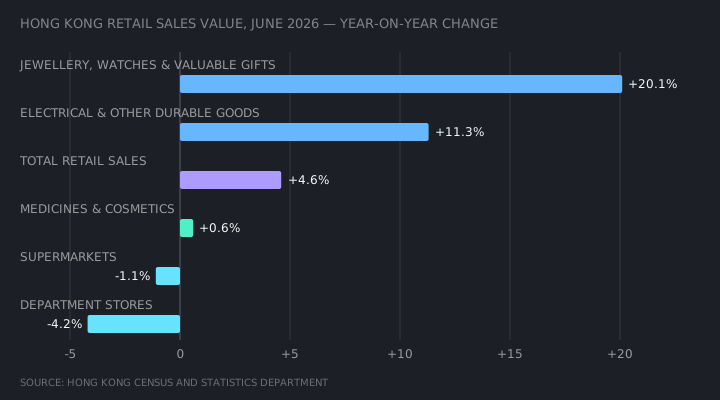
Read together, those four numbers describe a spending pattern rather than a beauty-specific one. Consumers spending more overall are directing a disproportionate share of the increase toward jewellery and durable goods — categories with a gifting and status component — and away from the general-merchandise formats that have historically hosted beauty counters. Medicines and cosmetics at 0.6% sits closer to the declining channels than to the categories capturing the acceleration, which is what you would expect from a category that has not repositioned toward whichever format currently holds the consumer's attention.
None of this identifies the winning format for any single retailer. The release does not break beauty spending out by e-commerce, cross-border purchase, or specialist store, and inventing that split would be exactly the kind of number this brief will not put in front of you. What the release does support is the framing: if the beauty category has a growth problem, it looks more like a channel and positioning problem than a demand problem, because demand for discretionary and gifting-adjacent spending is plainly visible in the same month's data.
What this means for a quarter of decisions
Start by testing whether your assortment sits in the categories customers are actually spending on. Gifting-format SKUs — sets, limited editions, higher price points with a valuable-gift character — track closer to the jewellery and durable-goods pattern than to the flat medicines-and-cosmetics line. An assortment skewed toward replenishment basics is competing in the slower-growing half of the same release.
Then reassess reliance on department-store-adjacent channels. A retailer whose primary Hong Kong distribution is counter space in a department store is selling through a format that declined 4.2% in the same month cosmetics grew 0.6%. A flat category inside a shrinking channel compounds rather than offsets, so it is worth modelling what share of sales sits in that channel specifically before assuming the category figure describes the business.
One thing not to do: read 0.6% as market weakness and cut marketing spend on that basis. The overall market accelerated in the same month; the category simply did not capture its share. Cutting spend while the underlying consumer is visibly spending more elsewhere risks ceding share rather than protecting margin.
What to track next
The Census and Statistics Department publishes this release monthly, with quarterly and annual revisions. The number worth watching is not the medicines and cosmetics growth rate on its own but its spread against total retail growth — the gap this brief opened with. A narrowing spread would say the category is starting to capture its share of the broader recovery. A widening one would confirm the channel-and-positioning read above, and argue for a direct response rather than waiting out the cycle.
So what
The number to carry into this quarter's planning is not "cosmetics grew 0.6%." It is "cosmetics grew 0.6% in a market that grew 4.6%, in the same month jewellery grew 20.1% and department stores fell 4.2%." A retailer tracking only its own category's headline will miss the reallocation happening around it. What this data supports is a review of assortment mix and channel exposure before the next monthly release — not a wait for the category number itself to move.