Platform ·
Concentration controls for a US$157.6B platform market
Momentum Works' 2025 estimate puts 98.8% of Southeast Asian platform GMV inside three systems. That makes platform dependence, margin leakage and response speed a governance job.
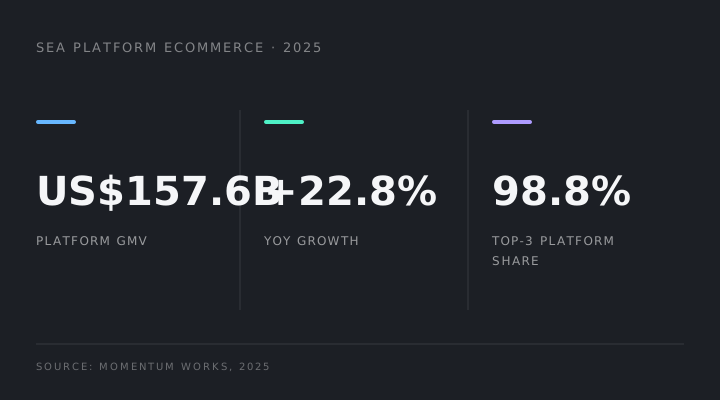
Momentum Works puts Southeast Asia's 2025 platform-ecommerce GMV at US$157.6 billion, up 22.8% year-on-year, with Shopee, Lazada and TikTok Shop — Tokopedia included on the Indonesian side — accounting for roughly 98.8% of that measure. Read as a ranking, the figure tells a seller little they did not already know. Read as an operating condition, it says that nearly every order now moves through a system whose rules the seller does not write. Rule dependence, margin leakage and response speed stop being channel-management details at that point and become governance questions.
Scope first. The public summary describes the market as platform ecommerce, and the excerpt does not set out the full inclusion and exclusion rules. Even bounded that way, 98.8% is a strong enough concentration signal to change how the channel should be run.
Concentration is a control issue, not only a share issue
Market-share analysis asks which platform is ahead. Governance asks something narrower and considerably more useful: which part of the operating model can a platform rule change overnight, and how long before the team sees it in the numbers?
Answering that means mapping dependence across five layers. Traffic dependence covers search ranking, platform ads, livestream discovery, affiliate reach and campaign placement. Commercial dependence covers commissions, free-shipping subsidy, voucher rules and creator incentives. Operational dependence covers fulfillment standards, late-shipment penalties, cancellation handling and customer-response timing. Data dependence covers whether the brand can identify, retarget or retain customers outside the marketplace. Organizational dependence covers whether ownership sits with a marketplace team, social team, performance team or country lead.
Where those layers stay invisible, selling on several platforms buys less protection than it looks like it does. The storefronts differ; the rule books behind demand, conversion and service recovery often do not.
What a US$157.6B market changes
US$157.6 billion says there is enough demand to justify serious channel investment. The 98.8% figure says that investment needs controls around it. Withdrawing from the leading platforms is not the answer — in most categories it would be commercially unrealistic. Treating platform exposure as a managed operating risk is.
Cube's narrower SEA-6 reading helps frame those operating choices without turning this into another share recap. Judge Shopee, TikTok Shop and Lazada against what the category actually demands in trust, demand generation and unit economics, rather than accepting their roles as fixed market facts. Each environment then needs its own control set.
Shopee's controls sit around campaign participation, paid ranking, price discipline, fulfillment exceptions and voucher profitability. TikTok Shop's sit around content production, creator commission, the economics of live and video formats, product-page claims and refund quality. Lazada's sit around official-store trust, assortment depth, premium conversion and after-sales promises.
Build a concentration-risk dashboard
A dashboard that opens with GMV is already looking at the wrong thing. Open with exposure: platform share of net sales, paid media share inside each platform, gross margin after marketplace costs, voucher and shipping subsidy, creator commission, return and cancellation rate, fulfillment exceptions and customer response time, reviewed weekly.
Two lines on that view carry more weight than the rest. Contribution margin after platform-specific costs shows whether a platform is quietly buying its own GMV through vouchers, ads, creator payouts and return handling. Customer portability shows what happens next: where repeat purchase depends entirely on platform ranking or creator reach, the brand has revenue but very little claim on the following order.
Country-level exposure belongs in the same view, separated out. Southeast Asia is not one operating market, and a rule change, campaign requirement or fulfillment constraint can land on Thailand quite differently from Indonesia or Vietnam. Regional averages do their job at board level; operating governance needs country and category granularity.
Assign owners before scale
Concentration risk stays invisible mostly because nobody owns it. Marketplace teams optimize store execution, performance teams optimize media, social teams optimize content, country teams optimize local revenue. Every one of those views can be correct while total channel risk goes unmanaged.
For 2026, one named owner for platform concentration governance is enough. That person does not have to run every platform. The job is to keep the exposure map current, review margin after platform costs, flag policy changes, and make sure channel tests leave behind reusable operating knowledge rather than isolated campaign results.
TikTok Shop shows why the role has real work to do. TikTok Shop Thailand presents creators, shoppable video, live commerce and in-app checkout as a single seller journey, and ThaiRisers highlights selected brands running affiliate, ads, campaigns, Mall and live commerce together. Each of those tools creates demand and a cost line, and the cost lines need one view. Shopee raises the same requirement through search ranking, campaign participation and fulfillment standards.
So what
A US$157.6 billion platform-ecommerce market with 98.8% top-platform concentration does not call for picking a winner. It calls for putting controls around dependence.
Use the leading platforms, because the demand is there. Govern them as systems that can change traffic, margin and service obligations without asking. The next decision is a weekly concentration-risk review covering platform net sales, cost-to-serve, paid reliance, creator reliance, return quality, fulfillment exposure and customer portability. Growth tells the team where the volume is. Governance tells the team whether the volume is still under enough control.
Sources
- thelowdown.momentum.asia/new-report-southeast-asias-platform-ecommerce-reaches-us157-6b-in-2025-with-top-platforms-expanding-share-to-98-8
- cube.asia/shopee-lazada-and-tiktok-shop-in-southeast-asia-what-the-data-shows-in-2026
- seller.tiktok.com/th
- newsroom.tiktok.com/tiktok-shop-spotlights-50-thai-brands-on-the-rise-with-tiktokshopthairisers?lang=th-TH
- euromonitor.com/digital-shopper-in-thailand/report