AI Ops ·
What response-SLA automation actually looks like on Shopee and Lazada
Both marketplaces score sellers on chat speed directly, in minutes. That makes customer-service automation a ranking input — and defines which part of it is safe to automate.
On most channels, response speed is a soft signal — buyers infer service quality from it, but no system scores it directly. Shopee and Lazada, the two marketplaces most HK and Southeast Asia SME sellers run alongside their own store, do the opposite. Response time there is a published, numeric account-health metric, and it feeds directly into what the storefront will let a seller do. Customer-service automation stops being a convenience feature at that point and becomes infrastructure the seller's ranking rests on.
The metric each platform actually scores
Shopee's seller education documentation defines Chat Response Rate as the share of buyer messages a seller responds to within 12 hours of receipt — measured over a rolling 30-day window and refreshed daily — alongside First Response Time and Average Response Time as related, separately tracked figures. Shopee's own guidance recommends keeping Chat Response Rate at 90% or higher; a rate at or below roughly 20% risks penalties.
Lazada's Seller Center help centre describes a tighter standard: a healthy average Chat Response Time is 30 minutes or below within the platform's same-day reply cycle, plus a separate "10-Minute Response Rate" metric — the share of chats opened between 8am and 11pm that get a reply within 10 minutes — where Lazada considers 50% or higher healthy. Maintaining Chat Response Rate above roughly 85% is described as a condition for Preferred Seller eligibility and related storefront perks.
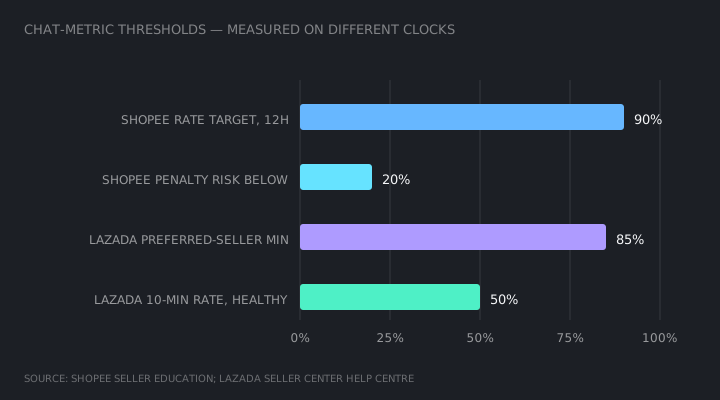
Reading both documents side by side, rather than either alone, brings out two things. First, these are not the same metric wearing different names. Shopee measures against a 12-hour cutoff and a 30-day rolling rate, Lazada against a same-day cycle and a 10-minute rate, so a seller running both platforms is being scored on two clocks at once — and a single canned "we'll respond soon" workflow tuned for one platform's threshold can still fail the other's. Second, both platforms state plainly that the metric gates program eligibility and storefront features rather than merely awarding a badge. A slow chat queue therefore has a cost measured in lost placement, not just a slower sale.
What is safe to automate against these clocks, and what is not
What the clock actually measures is time-to-first-touch, not quality of resolution — Shopee's First Response Time and Lazada's 10-Minute Response Rate both count the first reply, whatever it says. That makes triage-and-acknowledge the correct automation target. An agent that reads an incoming message, classifies it (order status, stock question, return request, general enquiry), and either answers directly from order data or sends an acknowledgement while routing to a person will clear both clocks on nearly every message, without ever having to compose the resolution itself.
The point at which this stops being safe is the same boundary as in any other AI customer-service deployment. A wrong "your order shipped" pulled from stale data, or a generated reply that commits to a refund policy the seller does not actually run, is worse than a slow human reply: it is confidently wrong rather than visibly absent. The response-SLA metrics reward speed on the first touch. They do not reward — and a seller's dispute rate will punish — a fast reply that turns out to be incorrect. So automate the acknowledgement and the lookup, and gate anything that commits the seller to an outcome (refund, replacement, exception to policy) behind a person, even where that person is slower than the platform's clock.
The channel constraint that shapes the automation itself
If a seller is also running WhatsApp as a customer-service channel alongside marketplace chat, the automation has to respect a structurally different constraint. WhatsApp's own Business Platform pricing documentation describes a 24-hour customer service window that opens when a customer messages first: inside that window a business can send free-form messages of any type; once it closes, only pre-approved template messages can go out, and their content is fixed at approval time. A triage bot built for Shopee or Lazada's open chat interface cannot be dropped onto WhatsApp unmodified. The response has to either land inside the live window or fall back to a template written and approved in advance — which means the acknowledgement message needs a pre-approved version sitting ready before the window closes, not generated fresh after it.
So what
Before automating anything, pull the actual response-rate numbers each platform's seller dashboard already reports — both platforms show sellers their own current figures — and compare them against the 90%/12-hour and 50%/10-minute standards above; that gap, not a general sense that "response could be faster," is the business case. Then scope the automation to first-touch triage and acknowledgement only, keep resolution with a person, and build the WhatsApp path around a pre-approved template rather than assuming free-form generation will always be available. Response-SLA automation of this kind — reading account-health thresholds and building the triage layer around them without overstepping into automated resolution — is one of the concrete use cases ELELAND AI, in development at eleland.ai, is being built to handle for multi-marketplace sellers.