แนวโน้ม ·
Southeast Asia is closing the low-value import gap
Vietnam, Thailand and Indonesia each rewrote the rules for cross-border parcels between 2025 and 2026. Different instruments, one direction, and a repriced small-parcel model.
ต้นฉบับภาษาอังกฤษ — บทวิเคราะห์นี้ยังไม่มีฉบับแปลภาษาไทย
For about fifteen years, a specific arrangement made cross-border e-commerce work. Most countries set a value threshold below which an imported parcel was waved through without duty, without VAT, and usually without a full customs declaration. The threshold existed because manually processing paperwork on a $12 parcel cost more than the revenue it raised. It was an administrative convenience, not a trade policy.
Then parcel volumes grew by several orders of magnitude, customs processing was automated, and the convenience became a subsidy — one flowing to cross-border sellers and away from domestic ones. Between 2025 and 2026, three of Southeast Asia's largest consumer markets withdrew it. They did so separately, through different legal instruments, on different dates, with different scopes. The convergence is the point.
What actually changed
Vietnam. Decision 01/2025/QD-TTg, issued 3 January 2025 and effective 18 February 2025, repealed Decision 78/2010/QD-TTg. Decision 78 had exempted goods imported via express delivery and valued at or below VND 1,000,000 — roughly US$40 — from import duty and VAT. The government's published explanation frames the change around tax policy consistency with international practice, broadening the tax base, and fairness for domestic production and business.
Thailand. From 1 January 2026, Thailand applies duty and VAT to online imported goods from 1 baht, ending the practical advantage created by the previous 1,500-baht (approximately US$46) duty-free treatment for low-value online imports. Thai Customs has framed the measure within a government "Quick Big Win" policy, and the publicly stated rationale is explicit about domestic SMEs being undercut by low-priced imports.
Indonesia. Minister of Trade Regulation No. 19 of 2026, effective 8 June 2026, revoked Permendag 31/2023 and replaced it with an explicit platform-model framework for trade through electronic systems. It is not primarily a tax measure — it works through platform obligation rather than the customs line. It tightens conditions on cross-border sellers, imposes merchant licensing and product-compliance duties on platforms, requires disclosure of promotion and ranking-feature rules plus advance notice of changes, adds AI-labelling and AI-governance duties, and carries enforcement up to access blocking and licence revocation.
| Market | Instrument | Effective | Mechanism |
|---|---|---|---|
| Vietnam | Decision 01/2025/QD-TTg | 18 Feb 2025 | Removes duty/VAT exemption below VND 1m |
| Thailand | Customs measure under "Quick Big Win" | 1 Jan 2026 | Duty and VAT apply to online imported goods from 1 baht |
| Indonesia | Permendag 19/2026 | 8 Jun 2026 | Platform gatekeeping and cross-border seller conditions |
Indonesia is the one to watch, because it is the most transferable. A duty threshold is a number a seller can price around. An obligation placed on the platform to police its merchants changes who is responsible for compliance, and that cannot be priced around — it decides whether you are permitted to list at all.
This is not a regional policy. It is a global one arriving regionally.
Nothing here is coordinated ASEAN action, and reading it as such would be wrong. Each government acted through its own instrument, for its own stated reasons. But the same withdrawal is under way well beyond Southeast Asia. The Hinrich Foundation's survey of the area documents advanced and developing economies alike reducing or eliminating thresholds, against a backdrop of volumes that explains the urgency: the EU cleared 4.6 billion parcels under its €150 threshold in 2024, and roughly 1.36 billion packages entered the United States annually under the Section 321 de minimis rule as of 2024.
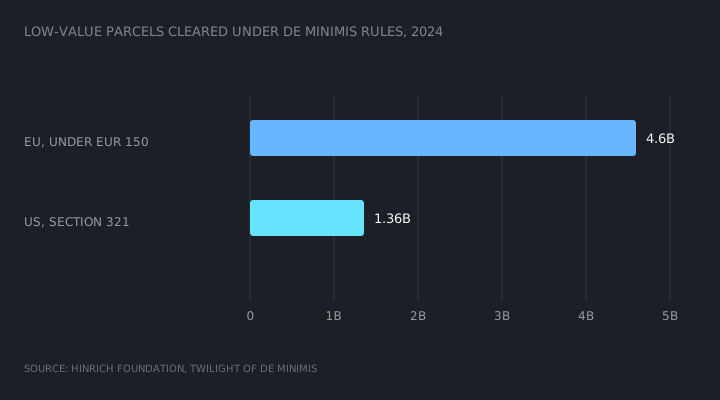
Those volumes are the whole argument. A rule designed so that customs would not waste effort on trivia is, at four billion parcels, no longer about trivia. Every government looking at its own version of that number reaches a similar conclusion, independently, which is why the direction is more reliable than any individual policy. The pressure producing it is arithmetic, and the arithmetic has not eased.
Plan against the direction, not the current thresholds. Any specific number in this brief may be superseded; the direction has been consistent across every market that has revisited the question.
What it repriced
The economics of cross-border small parcels rested on three things at once, and the change removes one and strains the other two.
The removed one is the landed-cost advantage. A duty-free $15 item competing against a domestically stocked equivalent that bore duty, VAT and local distribution had a structural head start that had nothing to do with the seller being better. That gap now closes to the size of the duty and tax, which for low-value goods is a meaningful proportion of the price.
The strained ones are speed and returns. Where every parcel now requires assessment rather than passing under a threshold, the customs step becomes a variable in delivery time rather than a formality. And a returns flow that was economically viable when the outbound leg carried no duty looks different once it does.
Set against the scale of what is being re-priced: e-Conomy SEA 2025, from Google, Temasek and Bain, sizes Southeast Asian e-commerce at $185 billion GMV for 2025 with $41 billion of revenue, within a digital economy above $300 billion GMV. Cross-border is a portion of that rather than the whole, and the reports do not break out a clean cross-border share — which is precisely why we will not quote one.
What we cannot tell you
Three genuine gaps, stated rather than filled.
We do not have reliable post-change volume data. Vietnam's change is eighteen months old, Thailand's roughly eight, Indonesia's a matter of weeks at the time of writing. Whatever effect these have on parcel volumes and on marketplace mix is not yet in published statistics that we would cite.
We do not have a defensible cross-border share of SEA e-commerce GMV. Estimates circulate; the ones we checked do not disclose their method.
And we cannot tell you how enforcement will actually work, which for Indonesia is the entire question. A platform-gatekeeping regulation is only as real as its enforcement pattern, and that pattern will be visible in about a year, not now.
So what
If you sell into these markets, the immediate work is arithmetic, not strategy. Rebuild landed cost per SKU for each market with duty and VAT included, at the actual rates for your HS classification, and identify which SKUs stop working. For low-value, low-margin items this will not be a marginal adjustment — some products simply exit.
Then decide, per market, between three responses: raise price and accept lower conversion, absorb the cost and accept lower margin, or move inventory in-market so the goods clear customs once in bulk rather than once per order. The third is the structural answer and it converts a variable cost into a fixed commitment, which is a different business with a different break-even. It is the right answer at volume and the wrong answer during a test.
For Indonesia specifically, treat Permendag 19/2026 as a compliance review rather than a pricing exercise, and start from your platform's seller requirements rather than the regulation text — the obligations land on you through the platform's terms, and those move faster than legal commentary.
Finally, build the assumption in. Any market you are entering that still has a generous de minimis threshold should be modelled as though it will not, because the list of markets that have revisited this and left it alone is short and getting shorter. A cross-border model whose viability depends on a threshold surviving is a model with a policy date in it that nobody wrote down.
On reading the platform-side costs that sit on top of these landed costs, see Platform fee schedules are public. Read them as a system.
แหล่งข้อมูล
- bain.com/about/media-center/press-releases/sea/e-conomy-sea-2025
- jdih.kemendag.go.id/peraturan/peraturan-menteri-perdagangan-republik-indonesia-nomor-19-tahun-2026-tentang-penyelenggaraan-usaha-perdagangan-melalui-sistem-elektronik-1
- jdih.kemendag.go.id/peraturan/download/5d4ff6c5-ae21-4591-81ed-4949d6e6ac1d/file_peraturan
- vanban.chinhphu.vn/?classid=1&docid=212259&pageid=27160
- vanban.chinhphu.vn/?docid=98022&pageid=27160
- baochinhphu.vn/ngung-mien-thue-hang-nhap-khau-duoi-1-trieu-dong-gui-qua-chuyen-phat-nhanh-102250103212054862.htm
- thailand.prd.go.th/en/content/category/detail/id/2078/iid/440097
- customs.go.th/data_files/8342f73dce85665090d55bb44eb9a0e4.pdf
- hinrichfoundation.com/research/article/trade-governance/twilight-of-de-minimis