แนวโน้ม ·
Platform concentration is the risk behind Southeast Asia's ecommerce growth
The regional headline still reads as growth, but a 98.8% top-three share changes how brands should think about dependency, margin and channel resilience.
ต้นฉบับภาษาอังกฤษ — บทวิเคราะห์นี้ยังไม่มีฉบับแปลภาษาไทย
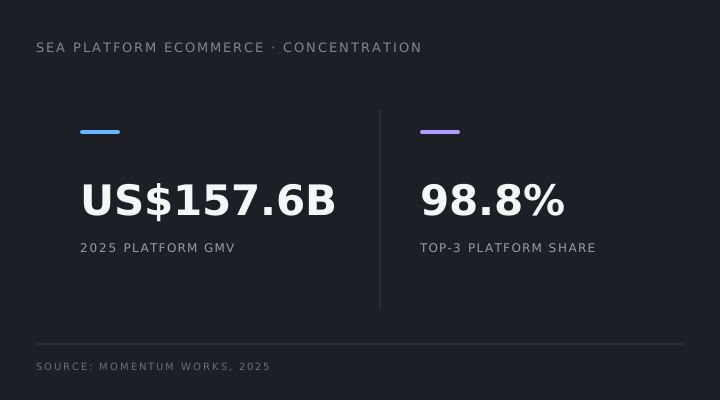
Southeast Asia's platform ecommerce headline is still a growth headline. Momentum Works' published summary puts 2025 platform ecommerce GMV at US$157.6 billion and says Shopee, Lazada and TikTok Shop — including Tokopedia in Indonesia — accounted for around 98.8% of that platform-GMV measure.
The first instinct is to read that as a platform ranking story, which is too narrow. The more important reading is dependency. A market can grow quickly and become less flexible for merchants at the same time. When almost all platform GMV sits inside three operating systems, the risk worth naming is not that ecommerce demand disappears. It is that the rules through which demand is reached become concentrated.
One caveat matters before going further. The public summary describes the market as platform ecommerce, and its full inclusion and exclusion rules are not given in the excerpt. Use the 98.8% figure as a platform-concentration signal, then, rather than as a universal share of every online purchase in Southeast Asia.
Concentration lowers entry cost, then raises exposure
The benefit is real. For a new or regionalising brand, the top platforms supply traffic, payments, promotion calendars, seller tools, logistics integrations and customer-service infrastructure that would be expensive to assemble alone. This is why platform share keeps pulling volume toward the centre: sellers want demand that already exists, and consumers want the selection and operational reliability platforms can subsidise or standardise.
The same structure raises exposure. Commission rules, advertising auctions, fulfilment requirements, campaign participation, ranking logic, account health metrics and customer-service penalties all sit outside the merchant's direct control. A change in any one of those layers can move margin faster than a change in consumer demand.
That is the practical meaning of a 98.8% top-three platform share. The brand is not only choosing sales channels. It is accepting platform policy risk as part of its operating model.
The three-platform market is not one platform
The concentration number should not flatten the market into one undifferentiated channel. Shopee, TikTok Shop and Lazada have different jobs.
Sea's disclosures show continued Shopee GMV, order and marketplace-revenue growth; Cube supplies the separate SEA-6 comparison. Treat all three as operating choices to be evaluated against a category's demand, trust and unit-economics requirements, not as fixed market roles.
Which is why the response to concentration is not simply choosing the largest platform. It is mapping platform jobs — asking where each marketplace fits on the route from demand creation to transaction to repeat purchase.
Dependency should be measured, not debated
Platform dependency becomes manageable once it is converted into a small set of weekly indicators. At minimum, a regional ecommerce dashboard should show share of GMV by platform, paid media share inside each platform, gross margin after marketplace costs, fulfilment exceptions, cancellation and return rates, and the percentage of customers reachable outside the platform.
That last measure is the one most often ignored. A platform can be a high-performing sales channel and still leave the brand with weak customer portability. If the customer relationship stays inside the platform, a future change in ranking, ad pricing or shop rules can cut sales while leaving the brand few direct levers.
For Southeast Asia this risk is not theoretical. The market's country fragmentation means a platform rule change does not land evenly. It can hit one market, one category, one fulfilment model or one seller type first. Regional averages are useful for strategy; operations need country-level exposure maps.
So what
The useful conclusion is not that brands should avoid Shopee, TikTok Shop or Lazada — in most categories that would be unrealistic. It is that platform concentration should be priced into the channel plan.
Use the big platforms, because they hold the demand. But write the dependency into the model: how much margin sits behind advertising, how much delivery performance depends on a single fulfilment route, how much promotion volume requires platform campaign participation, and how much customer data can be carried into the next purchase outside the same marketplace. Growth tells the team where the volume is. Concentration tells the team where the control risk sits.
แหล่งข้อมูล
- thelowdown.momentum.asia/new-report-southeast-asias-platform-ecommerce-reaches-us157-6b-in-2025-with-top-platforms-expanding-share-to-98-8
- jingpost.com/news/southeast-asia-ecommerce-war-shopee-tiktok-lazada
- cube.asia/shopee-lazada-and-tiktok-shop-in-southeast-asia-what-the-data-shows-in-2026
- bain.com/insights/e-conomy-sea-2025
- cdn.sea.com/investor/2Q2026/wFBC39MbqnfLb3MGY6LP/2026.08.11%20Sea%20Second%20Quarter%202026%20Results.pdf