เกณฑ์เปรียบเทียบ ·
The spread is the finding, not the average CPC
Public search benchmark tables report a $5.42 average CPC and a six-fold spread beneath it. The average is the least useful number on the page — here is how to read the rest.
ต้นฉบับภาษาอังกฤษ — บทวิเคราะห์นี้ยังไม่มีฉบับแปลภาษาไทย
Google does not publish cost benchmarks. That is worth stating first, because most articles presenting "Google Ads benchmarks" are not reporting Google data and do not say so.
What Google publishes is mechanism. Its documentation states that every time someone searches, Google Ads runs an auction to determine which ads show, their rank, and whether any show at all, and that higher quality ads can lead to lower prices and better positions. It also notes, usefully, that Quality Score is an aggregated estimate of overall performance and is not itself used at auction time to determine Ad Rank. Price is set per auction, per query, per competitive set. There is no list price, so there is nothing for Google to benchmark.
That leaves one substantial public dataset, worth using properly rather than either quoting uncritically or dismissing.
What the public numbers actually say
The widely circulated search advertising benchmarks, published by WordStream by LocaliQ, report these cross-industry averages:
| Metric | All-industry average |
|---|---|
| Cost per click | $5.42 |
| Click-through rate | 6.64% |
| Conversion rate | 8.18% |
| Cost per lead | $66.69 |
Those four numbers are the ones that get quoted, and they are the four least useful in the report, because the industry detail underneath shows a spread wide enough to strip the average of meaning as a reference point:
| Industry | Figure |
|---|---|
| Lowest CPC — Arts & Entertainment | $1.63 |
| Highest CPC — Attorneys & Legal Services | $9.87 |
| Highest CTR — Arts & Entertainment | 12.75% |
| Highest conversion rate — Animals & Pets | 16.22% |
| Lowest cost per lead — Arts & Entertainment | $26.84 |
A six-fold range between the cheapest and dearest click is not noise around a mean. It says the population is not one population. An advertiser comparing their CPC to $5.42 is comparing themselves to a blend of legal services and entertainment, which is not a comparison at all.
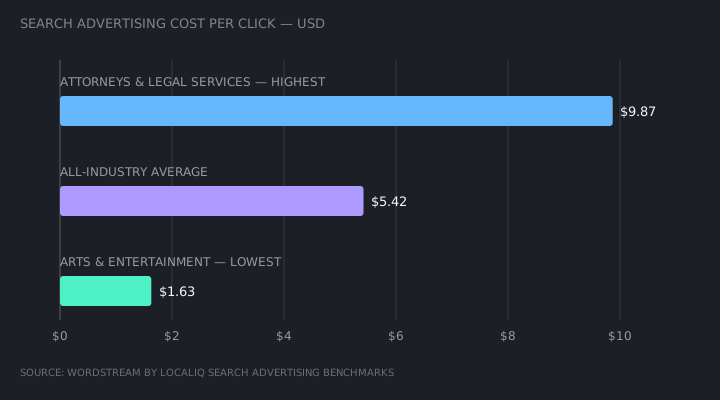
When the range is six times the low end, the average is a summary of nothing. Read the extremes and locate yourself between them.
Four rules for reading the table
Read the spread before the average. The question worth asking is not whether you sit above or below $5.42, but where you fall within the range for categories whose auction dynamics resemble yours. Legal services is expensive because a converted client is worth a great deal and a small number of firms bid hard for the same intent. If your category shares that structure, the legal figure tells you more than the mean does, whatever industry label you carry.
Check what the sample is, and accept that here you cannot. The published article states the data comes from thousands of customer advertising campaigns across Google Ads and Microsoft Ads. It does not disclose sample size, exact date range, or geographic coverage. That caveat is the most important thing on the page, and it should travel with every quote of these numbers. Figures are in US dollars, which constrains the geography question without settling it.
Treat "industry" as the vendor's taxonomy rather than yours. Benchmark tables sort accounts into a fixed list of categories, so a Hong Kong company selling B2B logistics software may land in whichever bucket fits worst. Two businesses under the same label can face entirely different auctions, and two under different labels can face the same one.
Trust conversion rate least. CPC and CTR are platform-measured and defined identically for everyone. Conversion rate is defined by each advertiser, who decides what counts — a form fill, a phone call, a newsletter signup, a purchase. An aggregate conversion rate averages across incompatible definitions, which makes it the most quoted and least comparable metric in the set. A benchmark conversion rate should never be used to judge your own.
The Hong Kong position
There is no Hong Kong equivalent of this dataset. The Census and Statistics Department, which publishes Hong Kong's official social and economic statistics, does not collect search advertising cost or performance series. No platform publishes Hong Kong auction prices. The benchmark tables in circulation do not state their geography and are denominated in US dollars.
So a Hong Kong advertiser has no external benchmark for search cost, and internal baselines carry the full weight. That is a limitation to design around, not one to fill with a foreign number relabelled.
What a benchmark can legitimately do
It does one thing well: catch order-of-magnitude errors. A cost per lead of $700 against a table showing $66.69 says something structural is wrong — the wrong conversion is being counted, match types are too broad, or the offer does not fit the query. That is a real and valuable use.
It cannot set a target. A target derived from an undisclosed sample in an unstated market is one you cannot defend when it is missed, or learn from when it is beaten.
So what
Use the published table once, at the start, as a screening test. Pull the two or three category rows whose auction structure resembles yours, check whether you sit within roughly the same order of magnitude, then close the table.
From there, benchmark against your own account: cost per qualified lead by campaign, by month, across at least four quarters, with the conversion definition written down so it stays fixed. That written definition is what makes the series comparable to itself, and self-comparability is the only kind you can actually verify.
When someone presents a benchmark figure, ask three things before accepting it: what was the sample, over what period, and in which market. If any of the three has no answer, the figure is context rather than evidence.
Our companion note on what public data exists for paid social costs in this region is at Meta ad cost benchmarks for Hong Kong do not exist.