品类 ·
TikTok Shop category strategy in SEA has to be local
Public Q1 2025 signals put health and beauty first in Singapore and Muslim fashion high in Indonesia and Malaysia — enough to reject one regional SKU plan.
英文原文 — 本篇文章的中文版本尚未发布。
The June 2025 public landing page for Statista and Momentum Works' TikTok Shop category chart reports a Q1 2025 snapshot rather than a current leaderboard, and the complete percentages are not visible publicly. What is visible is narrower: Singapore's largest TikTok Shop shopping category was health and beauty, while Muslim fashion was among the popular categories in Indonesia and Malaysia.
Narrow as it is, that signal is enough to break a common planning mistake. "Southeast Asia" is not a category strategy. The same TikTok Shop product logic can behave very differently across Singapore, Indonesia, Malaysia, Thailand, Vietnam and the Philippines. A regional deck can justify the opportunity; it cannot decide the SKU order, the creator brief, the launch calendar or the content angle.
The category is the cultural surface
Singapore's health-and-beauty signal says TikTok Shop is not simply a low-price shelf. It can carry products where proof, routine, ingredient trust, comparison, creator familiarity and repeat purchase all matter — which is a meaningful line for brands that have historically kept discovery on social platforms and conversion on marketplaces.
The Muslim-fashion signal from Indonesia and Malaysia says something else: localisation is not translation. It runs through lifestyle, religious context, campaign timing, fabric, fit, modesty expectations, model selection, creator identity, gifting seasons and payment behaviour. A regionally identical product title carrying a local-language caption does not come close to being local enough for a category like that.
TikTok Shop's own ThaiRisers programme adds a parallel operating clue from Thailand. The platform did not only highlight sales volume; it highlighted local brands, growth stories, products or content that created real interaction, and social or community contribution. ThaiRisers is a selected platform campaign rather than a market average, but the selection logic shows the kind of brand narrative TikTok Shop wants to make legible.
Q1 is a prompt, not a calendar
The timing needs the same care. Quarterly category GMV can be shaped by campaign windows, Ramadan and Hari Raya demand in Muslim-majority markets, inventory cycles, discount intensity and platform events. A Q1 category chart proposes hypotheses. Turning it directly into an annual media plan asks it to carry weight it was never built for.
The broader e-Conomy SEA 2025 report places Southeast Asian ecommerce inside a digital economy above US$300 billion GMV, and sizes ecommerce itself at US$185 billion GMV for 2025.
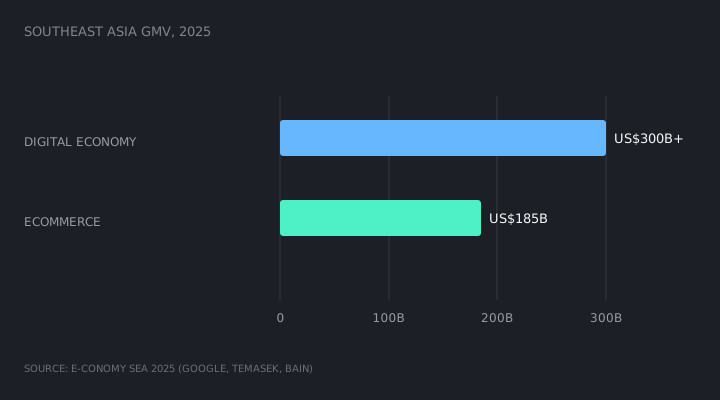
That top-level scale supports continued category testing, and it removes none of the country-level differences. A category can be structurally attractive at regional level and operationally poor in one market because the creator pool, logistics, price architecture or trust requirement does not fit.
For execution, a regional TikTok Shop programme is best run as a portfolio of country tests:
| Decision | Regional view can answer | Country view must answer |
|---|---|---|
| Opportunity | Whether TikTok Shop matters in SEA | Which market deserves the next test |
| Category | Which categories are visible | Which SKU and claim fit local demand |
| Content | Which format exists | Which creator and language converts |
| Calendar | Which quarters matter | Which festival, sale, or payday matters |
| Economics | Whether GMV is present | Whether contribution survives local costs |
The operational implication
Brands often centralise Southeast Asia because it looks efficient: one budget owner, one creative toolkit, one marketplace playbook. TikTok Shop pushes against that structure. These are Q1 2025 country signals, not current category rankings, and they work best as local test hypotheses rather than as three settled demand systems named Singapore health and beauty, Indonesian and Malaysian Muslim fashion, and Thai local-brand storytelling.
The minimum operating design is a country-by-country test grid. Each market gets its own SKU shortlist, creator archetypes, content claims, campaign calendar, order economics and refund review. Central teams can own the measurement frame and the creative quality bar; local execution should own product-market-language fit.
So what
The public category data supports one clear decision: do not build a single TikTok Shop Southeast Asia category plan. Use the region to justify the size of the opportunity, then split execution by country. The first question is not what sells on TikTok Shop in SEA. It is which local category grammar the product can honestly fit, and what evidence will say whether to scale it once the first orders settle.