平台 ·
Thailand's retail ecommerce preview maps four platform models
Euromonitor's public preview names price and logistics, creators, omnichannel fulfilment and price competition as distinct platform themes — hypotheses to test, not a channel playbook.
英文原文 — 本篇文章的中文版本尚未发布。
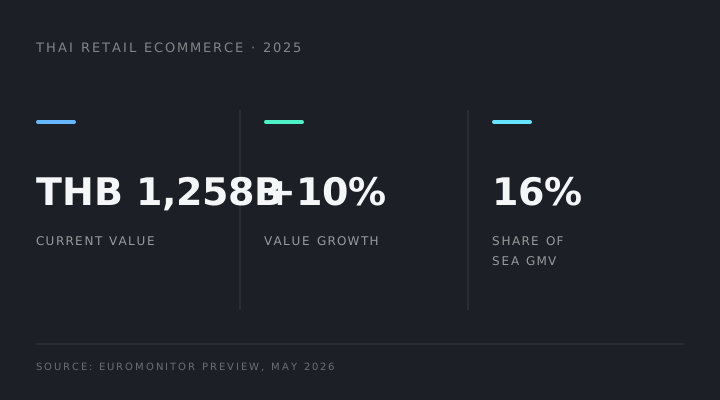
Euromonitor's May 2026 public preview describes Thai retail ecommerce as dynamic and intensely competitive. It reports 2025 current-value growth of 10% to THB 1,258 billion, and places Thailand at 16% of Southeast Asian GMV. That makes the preview a useful market frame. The full report is paid, however, and the published material does not establish detailed category prescriptions or platform performance comparisons.
The public preview distinguishes operating themes
The preview frames Shopee through price and logistics, TikTok Shop through creators, Makro through omnichannel fulfilment and Temu through price competition. Those labels distinguish where platforms may compete. They do not demonstrate that every category should reach for the same creative, fulfilment or pricing strategy.
Trade.gov offers a complementary public description of a mixed marketplace and local-retailer environment, and notes TikTok Shop's traction through social commerce and livestreaming. That strengthens the case for testing platform roles separately. It does not convert the Euromonitor themes into a platform ranking.
Cross-border price pressure is a separate operating constraint. Thailand's government has announced that overseas online-shopping imports valued from one baht will be subject to import duty and VAT from 1 January 2026. A low sticker price is therefore an incomplete comparison — landed cost, return responsibility, service language and delivery promise all belong in the margin model beside it.
Turn themes into testable hypotheses
A category team can test whether a creator-led route improves qualified product-page visits, whether a price-led route preserves contribution after vouchers and advertising, and whether an omnichannel promise improves successful fulfilment and repeat purchase. Replenishment products may make fulfilment reliability the first test. Beauty and lifestyle products may need creator proof. High-consideration products may need education, comparison and stronger after-sales service. Each is a hypothesis with its own measurement plan, and the public preview cannot decide which one holds for a particular product.
The same discipline applies to platform perception. YouGov's Thailand data supplies a brand-health context, while traffic, GMV, cancellation and net margin remain separate measures with separate meanings. A market-level growth figure is not evidence that an individual platform or SKU can grow profitably.
Keep the public-source boundary clear
What the public preview supports is the market-level growth frame and the named platform themes. Detailed causality, category economics and platform comparisons need a source that actually measures them, or a documented internal test. Keep those conclusions visibly separate rather than presenting them as findings from the paid report.
Handled that way, the source is useful without being overstated: it supplies a structured set of operating hypotheses, and category and merchant data decide which of them earns scale.
So what
Use the preview to define the questions for a Thailand platform test — price and logistics, creator performance, fulfilment, or competitive price pressure. Scale only once the chosen hypothesis is supported by current category conversion, service and unit-economics evidence.
资料来源
- euromonitor.com/retail-e-commerce-in-thailand/report
- trade.gov/country-commercial-guides/thailand-ecommerce
- thailand.prd.go.th/en/content/category/detail/id/2078/iid/440097
- tmogroup.asia/insights/top-online-marketplaces-thailand
- yougov.com/articles/53250-shopee-and-lazada-remain-thailands-most-recommended-e-commerce-brands-as-new-competitors-emerge