平台 ·
Meta rebuilt ad retrieval on GPUs. Read what changed, not what agencies say changed.
Meta's Andromeda system replaced rule-based ad retrieval with an end-to-end neural network in December 2024. The official numbers say what improved for Meta — not what to do about it.
英文原文 — 本篇文章的中文版本尚未发布。
Nearly everything circulating about "Meta's 2026 algorithm change" is agency commentary layered on top of a single technical blog post. The post itself is precise and dated: Meta published it on its engineering blog on 2 December 2024, describing a new ad retrieval system called Andromeda. Separating what it says, and what it pointedly does not say, from the interpretation stacked on top of it since is worth doing carefully.
What retrieval does, and why it needed rebuilding
Before an ad is ranked, shown or bid on, it first has to be retrieved — selected as a candidate at all, out of a pool Meta describes as running to tens of millions of ads. Retrieval is a filtering stage, not the auction. Meta's own account of the problem is capacity rather than creativity: the retrieval stage has to process roughly three orders of magnitude more ads than the ranking stages behind it, and that volume was itself growing, because Advantage+ automation generates more creative variations per campaign than a human-built campaign typically would. The old system was running out of headroom before it ran out of accuracy.
What changed, in Meta's own terms
The previous system, per the blog post, ran on "isolated model stages and numerous rule-based heuristics" — separate components handling different parts of the matching problem, stitched together by engineered rules that a person wrote. Andromeda replaces that with a single deep neural network trained end-to-end, run on NVIDIA Grace Hopper Superchips, with ad embeddings held in GPU local memory and feature extraction happening dynamically on-GPU rather than pre-computed on CPU beforehand.
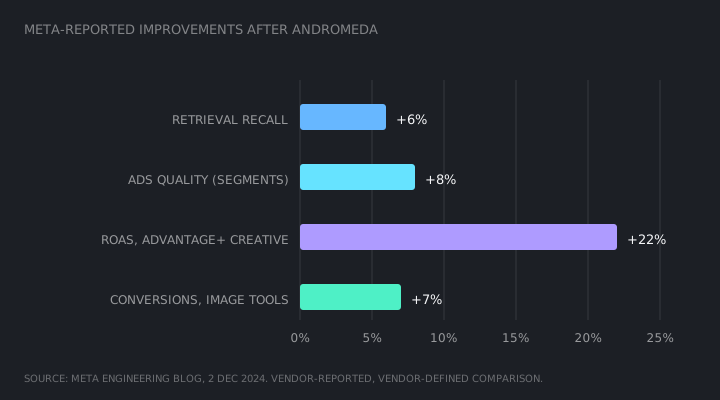
Meta reports four internal metrics for the change: a 6% improvement in retrieval recall, an 8% improvement in ads quality on selected segments, a 100x improvement in feature extraction latency, and a 3x increase in end-to-end queries per second. Two further, advertiser-facing figures appear in the same post: a 22% increase in ROAS for advertisers using Advantage+ creative, and a 7% increase in conversions for businesses using Meta's image generation tools.
Read each number as what it actually measures
The first four numbers describe system throughput and internal quality — how much more ad volume the system can evaluate, how fast, and how well it ranks a held-out test set against Meta's own definition of quality. They are engineering metrics, published by the team that built the system, about the system it built. None of that makes them false. It makes them a different kind of claim from "your account will perform 8% better," which is not something Meta published.
The two advertiser-facing figures — 22% ROAS, 7% conversions — sit closer to what an advertiser cares about, but they carry the caveats every platform-published lift figure carries. The comparison group, the campaign types included and the measurement window are all Meta's to define, and the public post details none of the three. Read them as Meta's own reported figures for its own chosen comparison, not as a guaranteed, case-independent outcome for any specific account.
A vendor's own performance claim, published in a vendor's own venue, is a data point about the vendor's chosen comparison — not a promise about your account.
What the structural change actually removes
The architecture shift matters more than either set of numbers. A rule-based retrieval stage has interpretable levers: heuristics an engineer wrote and, indirectly, targeting settings an advertiser can reason about, because a human-legible rule is doing part of the matching. An end-to-end neural retrieval stage offers no equivalent lever. The match between an ad and a user is a function learned from data rather than a rule anyone wrote down, and it is not inspectable by the advertiser in the way a rule-based filter was.
That amounts to a genuine shift in what an advertiser is doing at setup time. Manually narrowing an audience is a way of narrowing the retrieval pool by a legible rule; under a system built the way Meta describes Andromeda, retrieval already runs at a scale and speed where the trained model is doing the matching regardless of how much manual audience narrowing is layered on top of it. What an advertiser has a more direct hand in is the population of creative variations the system has to choose among — and Meta's own account of why the system needed rebuilding names exactly that: creative volume from Advantage+ automation was part of the capacity problem Andromeda was built to solve.
So what
The takeaway is not "targeting is dead." Meta has not published that claim, and this brief is not making it either. The narrower, verifiable claim is this: the mechanism connecting an ad to a viewer moved, on Meta's own account, from a stage built on human-written rules to a stage that is a trained model, in a system Meta dated to December 2024 and has continued to build on since. Anyone reasoning about a Meta account today should verify which retrieval generation and campaign type is actually live on that account — Meta's own rollout and help-center documentation is the source for that, not a third-party recap post — before restructuring spend around a claim about "the algorithm" that may not describe the system actually serving that account.