品类 ·
Hong Kong education: plan around the cohort, not the sector
No reliable public market-size figure exists for Hong Kong education services. What does exist is a demographic split between falling child cohorts and a stable adult learning population.
英文原文 — 本篇文章的中文版本尚未发布。
No single reliable public figure exists for the size of Hong Kong's education services market. The sector spans tutoring, enrichment, test preparation, professional and vocational training, and language schools, and no government or platform source publishes a consolidated total across all of it. A category brief on beauty or food and beverage can open with a growth rate from official statistics; this one cannot, and manufacturing a number to fill the gap would be exactly what this series refuses to put in front of readers. What is publicly sourced, and what should anchor this quarter's planning instead, is the demographic base the sector serves.
The demographic split that matters more than a market-size number
The Census and Statistics Department's year-end population release put Hong Kong's population at 7,510,800 at the end of 2025, up 10,200 (0.1%) from 7,500,600 a year earlier. Inside that total there were 31,100 births during 2025 against 50,000 deaths — a natural decrease of 18,900, offset by a net inflow of 29,100 residents that produced the small overall gain.
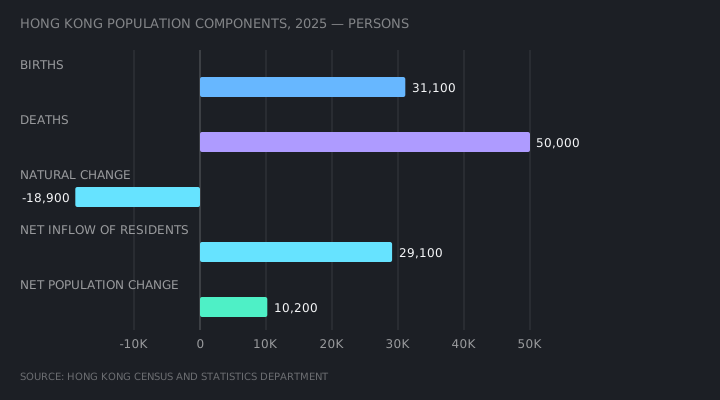
Of those figures, 31,100 births in a single year is the most concrete public data point available to an education services operator, and it points somewhere specific. The cohort entering the school-age population five to six years from now is smaller than it was even a few years ago, continuing a trend visible in Hong Kong's birth statistics for some time. An operator whose business depends on the size of the incoming kindergarten and primary cohort is planning against a shrinking base, whatever consumer sentiment or spending does this quarter.
That is not true across the whole sector. Adult and professional learning — upskilling, language training, vocational certification, continuing education tied to employment — draws on the working-age population and on net migration, which the same release shows running positive at 29,100 in 2025 even as births fall. A business in that segment faces a different demographic picture entirely and should not read the birth figure as a signal about its own demand.
The consequence is that "education services" is not one demand curve. A business plan treating it as one will read the direction of the market wrongly, depending on which half of the sector it is actually looking at.
The regulatory layer is a real constraint, not a market-size signal
Separate from demand, Hong Kong regulates schools and tutorial establishments under the Education Ordinance. An operator running a school — or, depending on scale and structure, a tutorial establishment — must register with the Education Bureau's Permanent Secretary for Education and hold a Certificate of Registration before operating. That compliance gate shapes how quickly a new operator can open or expand a physical location, regardless of demand. A well-financed entrant into tutoring or enrichment still has to clear registration before operating at whatever scale the demographic data might otherwise justify.
For planning, the effect is on speed. A category with strong demand and no compliance gate rewards moving fast. A category with a registration requirement rewards running compliance in parallel with commercial planning rather than after it, because the bottleneck on growth is as likely to be the registration timeline as customer acquisition.
What this means for a quarter of decisions
Before making any capacity decision, segment the business by the demographic base it actually draws on. A children's enrichment or exam-preparation business should model against the shrinking birth cohort rather than Hong Kong's overall population trend, which migration is holding up. An adult or professional training business should do the reverse: its addressable population moves with net migration and workforce participation, not the birth rate.
If the model depends on the birth-cohort segment, plan for a smaller intake each year rather than a stable one. New centres and additional classroom space sized against a flat or growing child population are sized against a trend the government's own data does not support. Here the absence of a growth number is itself the information: no public data suggests this segment is expanding, and public data does suggest the underlying cohort is shrinking.
And start Education Ordinance registration alongside site selection and hiring. For any operator whose model involves a registered school or tutorial establishment, the registration timeline is a planning input on the same level as lease negotiation, not an administrative step to handle once the commercial plan is settled.
So what
Where a market-size number would normally anchor a brief like this, the honest anchor is one demographic fact and one regulatory fact, both independently verifiable. Births are falling in a way that shrinks the cohort behind children's education services specifically, while adult and professional learning draws on a different, migration-supported population showing no such decline. What follows is to segment the business plan by which of those two populations it serves, and to treat Education Ordinance registration as a parallel-track dependency rather than a downstream step. Both are actionable this quarter, and neither needs a market-size figure that does not publicly exist.