แนวโน้ม ·
TikTok Shop's US$15.1B U.S. GMV makes content commerce global
Momentum Works' 2025 U.S. GMV figure shows TikTok Shop is no longer only a Southeast Asia story. For Asian brands, the opportunity is real, but the margin model has to be rebuilt for the U.S.
ต้นฉบับภาษาอังกฤษ — บทวิเคราะห์นี้ยังไม่มีฉบับแปลภาษาไทย
Momentum Works, citing Tabcut, estimates that TikTok Shop U.S. GMV grew 68% in 2025 to reach US$15.1 billion. This brief treats that as an analyst market-size estimate, then reads it against the related H1 2025 public summary and Southeast Asia operating evidence to see what it means for channel decisions.
The number matters because the U.S. is not an easy social-commerce test bed. Consumers there already have Amazon, Walmart, Target, brand sites and mature affiliate media. Building a US$15.1 billion GMV base in that environment says the model is not simply a Southeast Asian mobile-commerce story: content can create demand and keep the transaction inside the same app in a mature retail market too.
The U.S. validates a second growth curve
The H1 2025 public summary gives the interim signal. TikTok Shop global GMV reached US$26.2 billion in the first half of 2025, while the U.S. market reached US$5.8 billion, up 91% year-on-year. Indonesia was still the largest market in that half at US$6.0 billion. By the full year, the U.S. figure reached US$15.1 billion, implying material second-half scale.
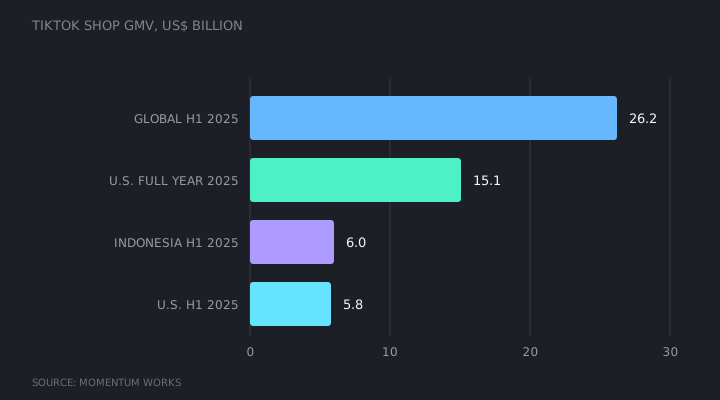
That changes how Asian brands should read TikTok Shop. Growth in the U.S. does not mean a Southeast Asian playbook can simply be translated. Test whether the underlying content-to-purchase pattern survives U.S. delivery, returns, creator, product-proof and fulfilment requirements.
A U.S. test should carry delivery timing, returns, reviews, customer service and brand credibility inside the economics model. A platform can create interest; weak fulfilment or unclear claims will turn that interest into refunds and support cost.
This is not a simple live-commerce win
TikTok Shop gets summarized as live commerce more often than it should. The U.S. evidence supports a more precise reading. The H1 2025 public summary reported that U.S. live GMV share rose from 10% to 14%, while video remained the main sales format. Short-form content, creator selection, product-page proof, discount discipline and fulfillment experience may therefore matter more for daily scale than any single live event.
The Southeast Asia operating model helps explain the structure. TikTok Shop Thailand's seller page places creators, shoppable video, live commerce and in-app checkout in one seller journey. The ThaiRisers cases show selected brands using affiliate, ads, campaigns, Mall and live sessions together. Format mix differs by market; the operating system is similar — content creates intent, product pages carry proof, and the platform captures payment.
For brands, the sharper question is not "should we run live?" It is which content format explains the product at the lowest credible cost, which creators can transfer trust to the product page, and which offer supports first purchase without damaging margin.
The Asian brand opportunity is real, but not plug-and-play
A US$15.1 billion TikTok Shop U.S. market gives Asian brands an additional route into consumer demand. Categories already proven through demonstration, creator review or short-video education in Southeast Asia have a reason to test it: beauty, personal care, food, small home goods, fashion accessories and hobby products among them.
The limits deserve equal weight. Compliance, logistics, returns, customer service, English content norms, creator fit and claim substantiation all have to be rebuilt. A Thai, Indonesian or Vietnamese selling angle may reveal the product's strength without surviving U.S. consumer expectations unchanged.
High-price, specification-heavy or after-sales-sensitive categories need an additional trust layer — stronger product pages, reviews, warranty language, a clearer return policy and a separate customer-service process — before scale spend begins.
Keep U.S. GMV separate from Southeast Asia GMV
The U.S. and Southeast Asia should not be merged into one TikTok Shop dashboard. Model average order value, creator fees, ad cost, returns, warehousing, compliance and customer support separately in each market; price bands and margin structures differ by country.
The practical starting point is to copy the tested hypothesis, not the asset. If a beauty product sells in Thailand because creators demonstrate visible product effects, the U.S. test should preserve the demonstration logic while rebuilding language, creator selection, proof points and trust signals for U.S. buyers.
So what
TikTok Shop's estimated US$15.1 billion U.S. GMV in 2025 indicates that content commerce is not a single-region behaviour. It does not prove that every brand can enter profitably. The decision metric should be net sales, refund rate, fulfilment cost, creator cost and contribution margin, not the headline GMV number.
For Asian brands, the next step is to decide whether the product has a content-explainable reason to buy, whether the U.S. fulfillment and trust stack can support it, and whether creator-led acquisition still leaves margin after returns. What is worth replicating is not the Southeast Asian video; it is the testing system behind it.
แหล่งข้อมูล
- thelowdown.momentum.asia/new-report-tiktok-shop-u-s-gmv-grew-68-to-reach-us15-1b-in-2025
- thelowdown.momentum.asia/new-report-tiktok-shop-doubles-global-gmv-in-h1-2025-with-u-s-market-hitting-us5-8-billion
- seller.tiktok.com/th
- newsroom.tiktok.com/tiktok-shop-spotlights-50-thai-brands-on-the-rise-with-tiktokshopthairisers?lang=th-TH